
Palisade Fence Height and Price Guide in South Africa Covering Costs, Installation, Durability, Safety and Material Options
Finding clear information about Palisade Fence Height and Price Guide in South Africa can be difficult. Many property owners struggle with this challenge.
Choosing the right security solution shouldn’t be confusing. This steel palisade fencing cost guide helps SA property owners make smart decisions.

Handyman Pretoria has helped many clients choose the right perimeter protection. We support both residential and commercial security needs.
This guide covers standard configurations including 1.8m, 2.1m, 2.4m, and 3.0m options. You’ll learn about steel pales, horizontal rails, posts, and anti-tamper fittings.
Finishes like hot-dipped galvanised or powder coated options affect your investment. We help you compare palisade fence quotes confidently and find the best value.
Discover which configuration suits your security needs. Let’s explore the palisade fencing price per metre options available – Contact Us
Why Palisade Fencing Remains South Africa’s Top Security Choice – Palisade Fence Height and Price Guide in South Africa
Property owners throughout South Africa continue choosing palisade fencing over alternative security solutions. It offers an unmatched combination of visibility, durability, and proven intruder deterrence. We’ve installed hundreds of palisade systems across Pretoria and surrounding areas.
The feedback consistently confirms what security professionals have known for decades. This robust steel fencing option delivers long-term protection. It adapts to residential homes, commercial premises, and industrial facilities alike.
The perimeter security solution you select today will protect your property for decades to come. Understanding the specific advantages of palisade systems helps you make an informed investment decision. This balances security effectiveness with practical considerations like maintenance requirements and visual appeal.
The Security Benefits of Steel Palisade Fencing
Steel palisade fencing creates a formidable physical barrier whilst maintaining excellent visibility through your property boundary. Unlike solid walls that provide hiding spots for intruders, this see-through design allows security personnel to monitor activity. Neighbours can also watch both sides of the fence line.
We find this transparency particularly valuable for South African properties. Visibility significantly enhances overall security strategies.
The pointed pale tops serve dual purposes that work together brilliantly. Physically, they make climbing extremely difficult and dangerous for would-be intruders. Psychologically, they communicate that your property takes security seriously.
This often deters criminals before they even attempt unauthorised entry.
Anti-climb spikes come in several configurations to match your security requirements. Single pointed tops offer basic deterrence suitable for lower-risk residential areas. The devil’s fork palisade design features a 3-spike palisade top with aggressive angles.
This provides enhanced protection for properties requiring stronger security measures. Rounded and notched designs balance security with a slightly softer aesthetic appearance.
The mild steel fencing security advantage becomes apparent when comparing palisade to alternative fencing materials. Steel’s inherent strength withstands attempted forced entry far better than timber, vinyl, or wire mesh options. An intruder would need specialised cutting tools and considerable time to breach properly installed steel palisade fencing.

Understanding Standard Palisade Fence Heights
South African properties typically utilise four main height configurations. These have become industry standards through practical application. These standard palisade fence heights balance security effectiveness with installation feasibility and cost considerations.
The 1.8-metre height suits residential properties where perimeter definition and basic security deterrence meet neighbourhood aesthetic standards. This height prevents casual trespassing whilst maintaining an approachable appearance. It works well in suburban settings.
We recommend 2.1-metre installations for homeowners seeking enhanced security without moving into commercial-grade specifications. This additional 300mm makes climbing significantly more challenging. It still fits within most residential contexts.
Commercial premises typically specify 2.4-metre fencing that creates a serious security barrier. This works around business properties, warehouses, and retail facilities. This height communicates professional security standards whilst remaining cost-effective for longer perimeter runs.
Industrial and high-security applications demand 3.0-metre installations that provide maximum deterrence. These suit facilities storing valuable equipment, sensitive materials, or requiring stringent access control. This imposing height, combined with appropriate pale top designs, creates a formidable security barrier.
It meets insurance and safety requirements for high-risk properties.
Essential Palisade Fence Components
Every effective palisade system comprises several interconnected components that work together to create lasting security. Understanding this palisade fence components list helps you appreciate the engineering behind what might initially appear simple. We’ll break down each element so you can make informed decisions.
These specifications match your security requirements and budget.
Steel Pales: Corrugated vs Angle Iron Options
The vertical steel palisade pales form the visible face of your security barrier. Choosing between profile types significantly impacts both performance and cost. W-section pales—also called corrugated pale fencing—feature a wave-shaped profile.
This provides exceptional strength through its geometric design. This corrugation creates natural rigidity that allows the pale to resist bending and forced entry attempts.
We typically specify W-section pales in 70mm or 62mm widths. This depends on the spacing and security level required. The beauty of corrugated profiles lies in their strength-to-weight ratio.
You can achieve excellent security with thinner steel gauges (1.5mm to 2.5mm) for residential applications. Industrial settings benefit from heavier 3mm to 3.5mm thickness options.
D-section pales offer a more economical alternative with their half-round profile measuring 65mm wide. These pales provide solid security performance at a lower material cost. This makes them popular for longer perimeter runs where budget constraints matter.
The smooth curved surface also presents an aesthetically pleasing appearance. Some property owners prefer this over the angular corrugated design.
Both pale types accommodate various pale head designs that determine your security level. Beyond the pointed and 3-spike palisade pales we mentioned earlier, you’ll find rounded tops. Rounded and notched configurations, and square tops work for locations where aggressive spike designs aren’t necessary.
| Pale Profile | Width Options | Thickness Range | Best Application |
|---|---|---|---|
| W-Section (Corrugated) | 70mm, 62mm | 1.5mm – 3.5mm | High-security commercial and industrial properties |
| D-Section | 65mm | 1.5mm – 3.5mm | Residential and budget-conscious commercial installations |
| Angle Iron Palisade | 40mm, 50mm | 4mm – 6mm | Heavy-duty industrial perimeters requiring maximum strength |
Galvanised vs Powder Coated Finishes Explained
The finish you select dramatically affects fence durability and lifespan. This is particularly true in South Africa’s diverse climate zones. We always emphasise that proper coating determines whether your fence lasts 15 years or 30+ years.
This depends on minimal maintenance requirements.
The hot-dip galvanising process involves immersing fabricated steel components into molten zinc at approximately 450°C. This creates a metallurgical bond where zinc actually alloys with the steel surface. This typically achieves 450 grams per square metre coverage.
The galvanised steel finish provides remarkable corrosion protection through two mechanisms: barrier protection and sacrificial protection. Zinc corrodes preferentially to protect the underlying steel.
We’ve seen hot-dip galvanised installations remain structurally sound for 25-30 years in Pretoria’s climate. The finish is essentially maintenance-free and self-healing. Minor scratches that expose steel are protected by surrounding zinc through galvanic action.
The silvery-grey appearance suits industrial and commercial settings perfectly. Some find it less aesthetically appealing for residential properties.
Powder coating offers a weather-resistant coating in various powder coating colours. These include green, black, white, grey, and custom options that match your property’s aesthetic. The application involves electrostatically charging polymer powder particles that adhere to the steel.
These then cure at high temperature to create a tough, uniform finish. This process delivers excellent UV resistance and a professionally finished appearance.
The ultimate protection comes from duplex coating—powder coating applied over galvanised steel. This combination provides zinc’s corrosion resistance with powder coating’s aesthetic appeal and additional barrier protection. We recommend duplex coating for properties where appearance matters and budget allows the premium investment.
| Finish Type | Protection Lifespan | Maintenance Requirements | Aesthetic Options |
|---|---|---|---|
| Hot-Dip Galvanised | 20-30 years | Virtually none | Silvery-grey only |
| Powder Coated | 10-15 years | Occasional touch-ups | Multiple colour options |
| Duplex (Galvanised + Powder) | 30+ years | Minimal | Multiple colour options with maximum protection |
Posts, Rails, and Anti-Tamper Hardware
The structural framework that supports your palisade pales determines overall system strength and longevity. Palisade fence posts and rails must be properly specified to handle wind loads and attempted forced entry. They must also withstand decades of environmental exposure without failure.
Square posts come in three common sizes matched to fence height requirements. We use 60×60mm posts for 1.8m residential fences. WOur team uses 80×80mm posts for 2.1m and 2.4m installations.
We use 100×100mm posts for 3.0m high-security fencing. These posts are typically spaced at 2.75m centres. We sometimes reduce spacing to 2.5m for areas with high wind exposure.
I-beam posts measuring 100×55mm offer an alternative profile. Some installers prefer these for their strength characteristics and slightly lower material cost. Both post types require proper concrete foundations.
We typically excavate 600mm deep for 1.8m fences. We excavate up to 900mm deep for 3.0m installations, ensuring stability that lasts decades.
Horizontal rails fabricated from angle steel connect posts and support the palisade pales at consistent spacing. The palisade panel dimensions determine whether you need two rails (for 1.8m fences) or three rails. Three rails work for 2.4m and 3.0m heights.
Rail sizes of 40×40×4mm suit lighter residential applications. 50×50×6mm angle iron provides the strength required for commercial and industrial installations.
Fishplates measuring 40×8mm and 140mm long connect rails to posts at straight sections. Longer 215mm fishplates are specified for corner connections. These seemingly minor components play crucial roles in maintaining structural integrity across the entire fence line.
The security hardware separates professional installations from amateur work. Anti-tamper shear nuts—also called breakaway nuts—allow installation with standard tools. They prevent removal once tightened.
The hex portion shears off at a predetermined torque. This leaves a smooth cone that can’t be gripped by conventional tools.
We specify M12×30mm cuphead bolts with anti-tamper shear nuts for rail fixings. We use M8×25mm T-bolts with shear nuts for pale attachments. Some high-security applications warrant stainless steel huck pins and collars.
These require specialised installation and removal tools, virtually eliminating unauthorised disassembly possibilities.
| Component Type | Standard Specifications | Material Grade | Security Function |
|---|---|---|---|
| Square Posts | 60×60mm to 100×100mm | Mild steel, hot-rolled | Primary vertical support structure |
| Horizontal Rails | 40×40×4mm or 50×50×6mm angle steel | Mild steel | Connect posts and support pales |
| Fishplates | 40×8mm, 140mm-215mm length | Mild steel | Secure rail-to-post connections |
| Anti-Tamper Hardware | M12×30mm and M8×25mm with shear nuts | Grade 8.8 steel or stainless steel | Prevent unauthorised disassembly |
This comprehensive approach to component selection and specification ensures your palisade fence delivers the security performance you’re investing in. We’ve learned through years of installations that cutting corners on hardware leads to premature failure. Undersizing structural components creates security vulnerabilities.
Every component receives careful consideration to match your property’s specific security requirements. We consider environmental conditions and budget parameters.
Palisade Fence Height and Price Guide in South Africa (1.8m, 2.4m, 3.0m)
Understanding your palisade fence investment starts here with comprehensive pricing breakdowns for all three standard heights. We’ve prepared detailed cost analyses that show precisely where your money goes, from materials to installation. This transparency helps you make informed decisions and budget accurately for your security fencing project.
Each height category serves different security needs and property types. The pricing varies based on material thickness, component specifications, and installation complexity. Let’s explore the detailed costs for each option so you can determine which height delivers the best value.
1.8m Palisade Fencing: Residential Security Pricing
The residential palisade fence height 1.8m represents our most popular choice for homeowners across South Africa. This height strikes the perfect balance between effective security and neighbourhood aesthetics. It’s tall enough to deter casual intruders whilst remaining cost-effective for most suburban properties.
Standard panels measure 2.75m wide and contain 17 pales made from 70mm W-section steel. You can choose between 2mm, 2.5mm, or 3mm thickness depending on your security requirements and budget. The thicker the pale, the more robust your fence becomes.
Detailed Price Breakdown Per Metre
Here’s exactly what the 1.8m palisade fencing price looks like for every component. These figures reflect current market rates for quality materials and professional installation.
| Component | 2mm Thickness | 2.5mm Thickness | 3mm Thickness |
|---|---|---|---|
| Material Cost Per Metre | R285 – R320 | R340 – R385 | R425 – R475 |
| Installation Labour Per Metre | R180 – R220 | R180 – R220 | R180 – R220 |
| Complete Package Per Metre | R465 – R540 | R520 – R605 | R605 – R695 |
| Standard Panel (2.75m) | R1,280 – R1,485 | R1,430 – R1,665 | R1,665 – R1,910 |
The 1.8m palisade price per metre includes all essential components: W-section pales, 50×50×6mm angle steel rails, posts, and fishplates. We use M8×25 T bolts with shear nuts for pale fixings and M12×30 cuphead bolts for rail connections. These security fixings prevent tampering and unauthorised removal.
Material costs represent about 60-65% of the total package price. The remaining portion covers skilled labour, equipment, and professional installation. This ensures your fence stands straight and secure for decades.

This height works brilliantly for specific property types and security scenarios. We recommend the cost of 1.8m palisade fencing investment for practical protection without creating a fortress appearance.
- Residential properties: Suburban homes, townhouse complexes, and estate perimeters where moderate security meets visual appeal
- School boundaries: Educational facilities requiring secure boundaries whilst maintaining visibility for supervision
- Recreational areas: Sports facilities, parks, and community centres needing defined boundaries with deterrent capability
- Retail premises: Small shops and standalone stores in moderate-risk areas requiring after-hours protection
- Sectional boundaries: Internal property divisions where full industrial-grade security isn’t necessary
The 1.8m height prevents easy climbing whilst allowing reasonable visibility through the pales. This visibility can actually enhance security by eliminating hiding spots. It enables passive surveillance from neighbours or security patrols.
Installation Costs and Timeline
Understanding the palisade fence installation cost requires looking beyond just labour rates. The complete installation process involves site preparation, precise measurements, post setting, panel assembly, and final adjustments.
For a typical residential installation of 50 metres, expect the following timeline:
- Day 1: Site preparation, marking post positions, excavating post holes to 600mm depth
- Day 2-3: Setting posts in concrete, allowing initial cure time, checking alignment
- Day 4: Installing rails, attaching pales, fitting fishplates and security fixings
- Day 5: Final inspections, touch-up painting if required, site cleanup
Labour costs for professional installation typically range between R180-R220 per metre depending on ground conditions. Rocky or heavily compacted soil increases excavation time. Sloped terrain requires stepped installations that demand additional precision and labour hours.
The palisade fencing supply and install package simplifies your project management. We handle everything from material procurement to final installation. This ensures component compatibility and professional workmanship throughout.
2.4m Palisade Fencing: Commercial Property Solutions
The commercial palisade fence 2.4m height delivers serious protection for enhanced security needs. This popular commercial standard provides excellent deterrence whilst maintaining the professional appearance businesses require.
At this height, we upgrade to heavier posts—100×45mm TFB sections that handle the increased load. The fence uses the same 70mm W-section pales available in 2mm, 2.5mm, or 3mm thickness. Each 2.75m standard panel contains 17 pales.
Complete Cost Analysis Per Metre
The 2.4m palisade fencing cost reflects the additional materials and engineering required for this taller installation. Here’s your comprehensive pricing guide:
| Component | 2mm Thickness | 2.5mm Thickness | 3mm Thickness |
|---|---|---|---|
| Material Cost Per Metre | R395 – R445 | R465 – R525 | R565 – R635 |
| Installation Labour Per Metre | R220 – R270 | R220 – R270 | R220 – R270 |
| Complete Package Per Metre | R615 – R715 | R685 – R795 | R785 – R905 |
| Standard Panel (2.75m) | R1,690 – R1,965 | R1,885 – R2,185 | R2,160 – R2,490 |
The 2.4m palisade price per panel includes heavier-duty posts designed specifically for this height. We also incorporate M12×500 threaded rods with nuts for mid-bay support on longer runs. This ensures structural integrity even in high-wind conditions.
Quality components make the difference between a fence lasting 20+ years and one requiring repairs within five. We never compromise on material specifications.
Why Businesses Choose 2.4m Height
Business owners who understand security requirements often ask about the 2.4m palisade fence. This height offers significant advantages for commercial applications:
- Climbing deterrence: The additional 600mm over standard residential height makes unauthorised access substantially more difficult
- Visual impact: Creates a clear security perimeter that discourages opportunistic crime before it starts
- Insurance compliance: Many commercial insurance policies specify minimum perimeter heights, with 2.4m meeting most requirements
- Visibility balance: Still allows visual security monitoring whilst providing effective protection
- Versatile applications: Suitable for warehouses, schools, retail parks, and medium-security facilities
Comparing 1.8m vs 2.4m palisade height often comes down to risk assessment. Properties storing valuable goods or operating in higher-crime areas typically benefit from enhanced security. Those requiring regulatory compliance also choose this height.
Supply and Installation Package Pricing
Our price for 2.4 metre palisade fence package includes everything needed for a complete solution. We’ve simplified the pricing structure to eliminate hidden costs and surprise expenses.
A typical 100-metre commercial installation breaks down as follows:
- Materials (2.5mm thickness): R46,500 – R52,500 including all posts, pales, rails, and fixings
- Labour and installation: R22,000 – R27,000 including excavation, post setting, and panel installation
- Total package price: R68,500 – R79,500 for turnkey installation
Installation timelines for commercial projects typically span 7-10 working days for 100 metres. This depends on ground conditions and site accessibility. We work efficiently to minimise disruption to your business operations.
We often schedule major works during off-hours or weekends when required. The palisade fence price breakdown we provide includes detailed line items so you understand exactly what you’re purchasing.
3.0m High Security Palisade Fencing: Industrial Grade Protection
Maximum security demands maximum specifications. The industrial palisade fence 3.0m height represents the pinnacle of perimeter protection. It suits high-risk facilities, critical infrastructure, and valuable asset storage.
At this height, engineering requirements change significantly. We use 150mm UB 14.0 posts—substantially heavier than lower heights. These handle the increased wind loads and structural demands.
For ultimate strength, this height offers 2mm, 2.5mm, 3mm, or even 3.5mm pale thickness options.
Comprehensive Pricing Guide Per Metre
The 3.0m high palisade fence price reflects premium materials and specialised installation expertise. Here’s your detailed cost analysis:
| Component | 2.5mm Thickness | 3mm Thickness | 3.5mm Thickness |
|---|---|---|---|
| Material Cost Per Metre | R595 – R670 | R715 – R805 | R865 – R975 |
| Installation Labour Per Metre | R285 – R345 | R285 – R345 | R285 – R345 |
| Complete Package Per Metre | R880 – R1,015 | R1,000 – R1,150 | R1,150 – R1,320 |
| Standard Panel (2.75m) | R2,420 – R2,790 | R2,750 – R3,165 | R3,165 – R3,630 |
The 3.0m palisade cost installed includes specialised components essential for this height. Multiple M12×500 threaded rods with nuts provide mid-bay support at strategic intervals. This prevents flex and maintains rigidity across long runs.
Installation labour costs increase for this height due to equipment requirements and precision needed. Heavier posts demand deeper excavations (typically 800mm) and more concrete per post. They often require crane or telehandler assistance for positioning.
Maximum Security for Industrial Properties
Clients asking about high security 3.0m palisade fence solutions typically manage serious security requirements. This height suits specific applications where compromise simply isn’t acceptable:
- Industrial facilities: Manufacturing plants, chemical works, and production facilities containing valuable machinery or materials
- Critical infrastructure: Power substations, water treatment facilities, and telecommunications installations
- High-value storage: Warehouses storing electronics, pharmaceuticals, or other high-value goods
- Government facilities: Administrative buildings, research centres, and secure compounds
- Transport depots: Logistics hubs, container yards, and vehicle compounds requiring maximum perimeter security
The 3 metre palisade fence for sale in our range includes optional security enhancements. Many clients add rotational anti-climb devices, razor wire, or electronic detection systems. These create layered security solutions that exceed basic physical barriers.
At this height, visibility becomes more limited, which actually suits many industrial applications. The imposing presence clearly communicates “no unauthorised access” whilst the robust construction backs up that message.
Comparing All Three Heights (Comparison Table)
Making the right choice means understanding how each height performs across key criteria. This palisade fence price breakdown comparison helps you evaluate which option delivers optimal value:
| Feature | 1.8m Height | 2.4m Height | 3.0m Height |
|---|---|---|---|
| Cost Per Metre (2.5mm installed) | R520 – R605 | R685 – R795 | R880 – R1,015 |
| Best Application | Residential properties | Commercial premises | Industrial facilities |
| Security Level | Moderate deterrence | Enhanced protection | Maximum security |
| Installation Time (50m) | 4-5 days | 6-7 days | 8-10 days |
| Post Specification | Standard TFB | 100×45mm TFB | 150mm UB 14.0 |
Evaluating affordable palisade fencing prices requires considering lifecycle costs rather than just initial investment. A properly specified fence at the correct height eliminates costly security incidents. It prevents insurance claims that far exceed any savings from undersizing your installation.
The average cost of palisade fencing in Johannesburg and other major centres tends toward these middle ranges. Prices significantly below these ranges often indicate compromised specifications. They may signal th
Making the Right Choice: Factors That Affect Your Palisade Fence Investment – Palisade Fence Height and Price Guide in South Africa
Your palisade fence represents a significant investment. We’re here to help you understand what influences the final price. Making the right choice requires balancing security requirements, budget constraints, and long-term value.
We want to ensure you select a solution you’ll be satisfied with for years to come. The decisions you make today about materials, height, and finishes will directly impact costs. These choices affect both your upfront expenses and ongoing maintenance needs.
Let’s explore the key considerations that help you maximise your investment. We’ll show you how to achieve the security levels your property demands.
What Influences Palisade Fencing Prices in South Africa
Understanding palisade fencing specifications helps you compare quotes accurately. Several interconnected factors determine what you’ll ultimately pay for your security fencing solution. These range from material choices to labour costs.
We’ve helped hundreds of property owners navigate these decisions. The factors affecting palisade price extend beyond the obvious. Knowing what drives costs empowers you to prioritise features that matter most.
Material Quality and Thickness Considerations
Steel thickness directly impacts both the strength of your fence and its price point. Thicker materials provide superior impact resistance and longevity. This proves essential for high-risk properties.
Material thickness significantly affects your fence’s ability to withstand forced entry attempts. Standard residential applications typically use 2mm to 2.5mm thick steel pales. Commercial and industrial installations demand thicker specifications, ranging from 3mm to 3.5mm.
| Steel Thickness | Application Type | Impact Resistance | Price Difference |
|---|---|---|---|
| 2.0mm – 2.5mm | Residential properties | Standard protection | Base cost |
| 2.5mm – 3.0mm | Commercial premises | Enhanced durability | +15-25% increase |
| 3.0mm – 3.5mm | Industrial facilities | Maximum strength | +35-50% increase |
Pale profile selection also influences both structural performance and cost. W-section pales offer excellent strength-to-weight ratios for most applications. D-section profiles provide additional rigidity for installations requiring maximum security.
Post spacing affects the quantity of materials required for your project. Standard 2.75-metre spacing proves most economical whilst maintaining structural integrity. Closer spacing increases material costs but may be necessary for specific security requirements.
Finish Options: Galvanised vs Powder Coating Costs
The finish you select dramatically impacts both appearance and longevity. Many clients ask us about galvanised versus powder coated palisade. The answer depends on your priorities regarding aesthetics, maintenance, and budget.
Galvanised finishes provide excellent corrosion protection at the most affordable price point. The hot-dip galvanising process coats steel with a protective zinc layer. This option suits properties where function matters more than appearance.
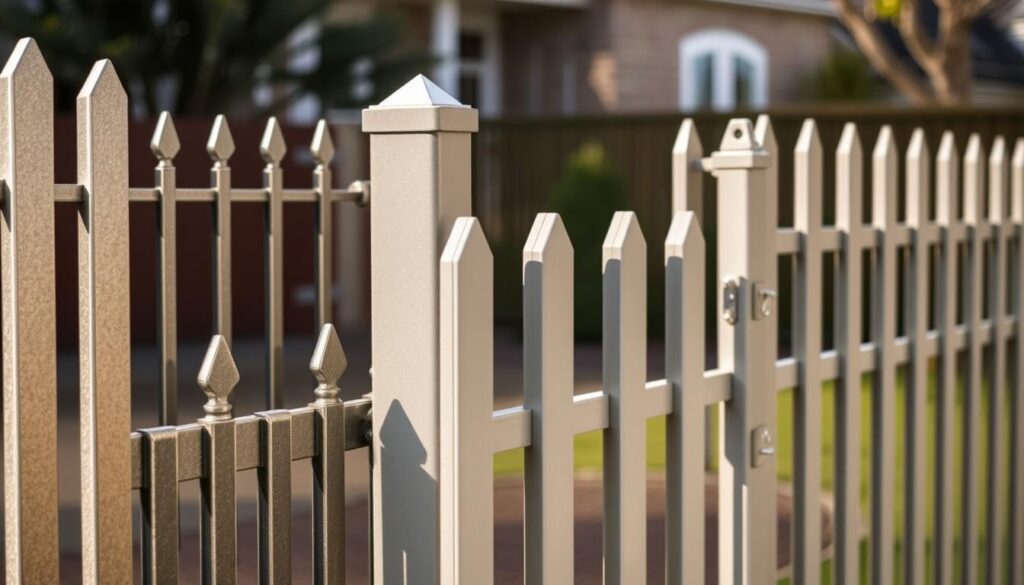
Powder coating adds a coloured layer over galvanised steel. This combines superior protection with attractive aesthetics. This dual-layer system offers maximum durability but increases costs by R50 to R120 per metre.
- Galvanised finish: Most economical option, excellent corrosion resistance, industrial appearance
- Powder coated finish: Enhanced aesthetics, superior weather protection, matches property colours
- Custom colours: Available for powder coating, may incur additional charges for special orders
- Maintenance requirements: Galvanised needs occasional inspection, powder coated resists fading longer
Labour Cost for Fence Installation
Professional installation represents a significant portion of your total investment. Labour costs vary based on ground conditions, access difficulty, and project complexity. Site-specific installation challenges often determine what you’ll pay.
Standard installations on level ground with good access typically cost between R150 and R250 per metre. Rocky terrain, steep slopes, or restricted access can increase labour expenses by 30% to 60%. These factors require additional time, specialised equipment, or extra manpower.
Finding reliable palisade installers ensures your fence meets structural standards. We recommend working with certified professionals who understand South African palisade fencing standards. Cutting corners on installation often leads to premature failures and additional costs.
Post installation methods also affect labour pricing. Concrete foundations provide maximum stability but require more time and materials. Driven posts work well in suitable soil conditions and reduce installation time significantly.
Additional Features: Devil’s Fork Spikes and Access Gates
Security enhancements and access solutions add to your base fencing costs. Devil’s fork (triple-pointed) pale tops increase the deterrent effect substantially. These additions cost approximately R15 to R25 per metre compared to standard tops.
The cost of palisade gates depends on width specifications and security features required. Standard pedestrian gates (900mm to 1200mm wide) typically range from R2,500 to R4,500 installed. Vehicle access gates for driveways cost significantly more due to their size.
- Single pale tops: Standard security level, most economical option
- Double pale tops: Enhanced deterrent, moderate price increase
- Devil’s fork (triple) tops: Maximum intruder deterrent, premium pricing
- Automated gate systems: Convenience and security, requires electrical work and controls
Security fencing regulations in South Africa may require specific features for certain property types. Commercial property palisade fencing often needs additional height or reinforcement to meet insurance requirements. We help clients understand these obligations during the planning stage.
Selecting the Perfect Height for Your Property
Choosing the right palisade fence height balances security effectiveness with budget considerations. Your property’s risk profile, location, and intended use should guide this decision. We’ve helped many clients navigate this choice successfully.
Height selection directly influences material costs, installation complexity, and visual prominence. Taller fences require stronger posts, deeper foundations, and more bracing. All of which increase expenses beyond the additional pale material.
Matching Fence Height to Security Requirements
The best palisade fence height for security depends on your specific threat assessment. Residential properties in low-risk areas often achieve adequate protection with 1.8-metre installations. This height deters opportunistic intruders whilst maintaining neighbourhood aesthetics.
Higher-risk locations demand increased height to prevent climbing attempts effectively. Commercial premises typically require 2.4-metre fencing as a minimum standard. Industrial facilities, schools, and high-value properties benefit from 3.0-metre installations.
Secure perimeter fencing for business must consider multiple factors beyond basic intrusion prevention. Visibility requirements, neighbouring properties, and local regulations all influence optimal height selection. We assess these variables during site consultations to recommend appropriate solutions.
- Evaluate your property’s specific risk factors and security history
- Consider visibility needs—some properties require see-through security
- Review local municipal regulations regarding fence height restrictions
- Assess whether additional height provides proportional security benefits
- Factor in visual impact on property value and neighbourhood harmony
Budget-Friendly Options Without Compromising Safety
High security fencing options exist across various price points. Strategic decisions help maximise protection within budget constraints. We often suggest phased implementations for large properties where immediate full coverage isn’t financially feasible.
1.8m palisade fencing for residential properties offers excellent value for money. This height provides substantial security whilst keeping material and installation costs manageable. Upgrading to thicker steel or premium finishes at this height often delivers better value.
Combining different heights across your property optimises both security and costs. Front boundaries facing public streets might use lower fencing for aesthetic reasons. Rear and side boundaries employ taller installations for enhanced protection.
Material choices significantly impact affordability without sacrificing essential protection. Galvanised finishes reduce upfront costs compared to powder coating. Proper maintenance ensures decades of reliable service.
How Handyman Pretoria Helps You Decide
We bring extensive experience in assessing properties and recommending optimal fencing solutions. Our consultation process examines your security needs, budget parameters, and site-specific factors. This comprehensive approach ensures you receive a solution perfectly matched to your requirements.
During site visits, we evaluate ground conditions, access points, and existing structures. Understanding these elements upfront prevents unexpected costs and delays during project execution. We provide transparent quotes that detail all factors affecting your investment.
Our team stays current with evolving security threats and fencing technologies. This knowledge helps you make forward-thinking decisions that remain effective for years to come. We explain trade-offs clearly, empowering you to prioritise features that deliver maximum value.
We also assist with navigating municipal requirements and obtaining necessary approvals where applicable. Many clients appreciate this support, as regulations can prove confusing and time-consuming. Our established relationships with local authorities often streamline approval processes.
Palisade Fence Height and Price Guide in South Africa: Conclusion
We’ve walked you through the complete palisade fence height and price guide for South Africa. Now it’s time to turn this knowledge into real security for your property.
Professional fence installation makes all the difference. Proper foundation depth, correct post spacing, and secure anti-tamper hardware installation ensure decades of reliable protection. These critical details separate effective security from costly mistakes.
At Handyman Pretoria, we help property owners across South Africa get a palisade fence price estimate tailored to their specific needs. Whether you’re looking at palisade fencing cape town prices, need to calculate palisade fencing cost in Johannesburg, we provide transparent quotes. Want to know the cost to install palisade fencing in durban? We offer clear pricing with no hidden surprises.
We work with trusted palisade fencing manufacturers gauteng and palisade fencing pretoria suppliers to buy palisade fencing panels at competitive rates. Looking to order custom height palisade or explore palisade fencing specials? We’ve got you covered.
Ready to take the next step? Contact Handyman Pretoria today for your free, no-obligation assessment. We’ll visit your property, discuss your security requirements, and provide detailed pricing options.
Our team of experienced palisade fence installers brings quality workmanship and local expertise to every project. Don’t compromise on security. Call us now or fill out our online quote request form.