
Heavy Load Removal: Efficient Grab Truck Logistics
Grab truck hire for rubble is the fast, hassle-free service Handyman Pretoria provides to cut clearance time and frustration. How quickly could we clear a renovation pile without upsetting your schedule?
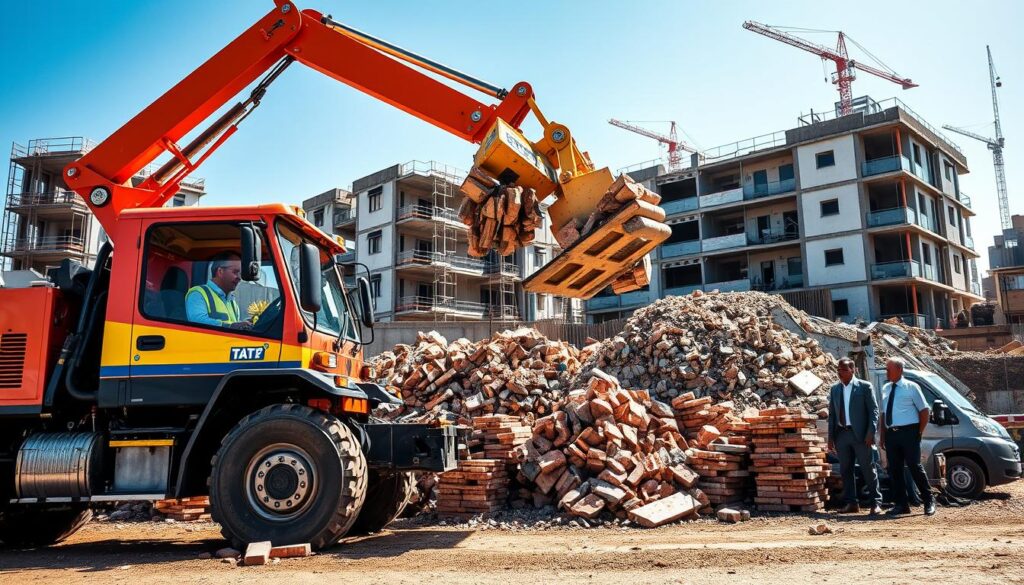
We run a modern fleet and a skilled crew that combine truck hire with a hydraulic grab to load debris far faster than manual labour. Our typical same-day or scheduled service reduces on-site disruption and keeps projects moving.
We focus on clear, compliant waste removal and better waste management by directing loads to licensed facilities and boosting recycling where practical. That means fewer labour hours, fewer vehicle trips and lower overall cost — which is what we mean by “cheapest load removal”.
Below you will find a clear service overview, what we remove, the areas we cover across Tshwane, fleet sizing, compliance and simple pricing comparisons to help you decide quickly – Contact Us
Opening paragraph for fast rubble removal in Pretoria – Grab truck hire for rubble
For quick on-site clearance, our Grab truck hire for rubble gets teams working again in 30–60 minutes, whether same-day or scheduled. We make waste removal simple and predictable so renovations and builds around the Union Buildings, Loftus Versfeld Stadium, Menlyn Maine and the Pretoria CBD stay on track.
We serve homeowners, contractors and property managers across local areas. Typical loads include mixed site waste, concrete, brick and garden spoil. Our direct grab loading cuts manual time and reduces vehicle trips.
Booking is straightforward: tell us what needs collection, confirm access, pick a time window and we arrive ready to load. We adapt to different client needs and advise on the best collection plan.
“Fast, dependable clearance keeps projects moving — we aim to finish loading within the hour on accessible sites.”

- Same-day or scheduled options
- Clear outcome: fast rubble removal and dependable waste removal
- Suitable for renovations, demolitions and garden clear-outs
| Service | Typical on-site time | Best for | Access note |
|---|---|---|---|
| Direct grab loading | 30–60 minutes | Scattered rubble, renovation waste | Clear turning space preferred |
| Scheduled collection | Same-day or booked slot | Planned site clears | Confirm gate and driveway access |
| Advisory planning | Consultation call | Complex sites / large loads | We advise on staging and permits |
Grab truck hire for rubble
We arrive with powered lifting gear and a matched vehicle so most on-site piles go from mess to clear within an hour. Our service is built around speed and simple planning.

What the service is and why it’s faster
We supply a hydraulic grab and the right truck hire option to lift, load and remove debris quickly. This cuts out many wheelbarrow runs and double-handling.
Less manual handling means faster turnaround from pile to disposal. That reduces labour time and lowers cost while keeping the site tidy.
Best-fit jobs
Ideal uses include bathroom or kitchen renovation waste, construction debris on active building sites, demolition clean-ups after wall removal, and garden clear-outs after landscaping.
Minimising disruption with wait-and-load
Our wait-and-load approach keeps the vehicle mobile on busy properties. We load in a short window so driveways stay clear and you avoid having a skip parked all week.
Typical on-site collection speed
Plan for a 30–60 minute collection window once access is confirmed and the load is staged. Our team coordinates with your site supervisor or homeowner to keep operations safe and moving.
“Quick, planned loading keeps works on schedule and reduces site downtime.”
What we remove and what needs special handling – Grab truck hire for rubble
We assess, separate and load onsite waste quickly to ensure each material goes to the correct licensed facility.
Common streams we accept:
- Concrete and bricks — clean inert material ideal for recycling.
- Soil and sand — often heavier loads that affect pricing and vehicle choice.
- Mixed building debris — plaster, tile offcuts and general demolition waste staged for collection.
- General construction debris — bulky or scattered building waste that needs managed loading.

Renovation waste versus construction waste
Renovation waste tends to be lighter and mixed — fixtures, trims and packaging. Disposal routes can be simpler when materials are clean and segregated.
Construction waste usually includes larger volumes and denser inert loads. That affects which licensed sites accept the load and how disposal is charged.
Segregation tips to improve recycling outcomes
Simple separation saves money. Keep clean concrete and brick apart from mixed waste. Store green garden material separately. Avoid contaminating inert piles with plastics or timber.
Good separation reduces tipping fees and speeds acceptance at licensed sites.
Controlled items and facility rules
Certain items — hazardous liquids, asbestos, batteries or chemical containers — are restricted. We may refuse, restrict or redirect these items depending on facility rules and local regulation.
“We follow licensed waste rules to protect clients from compliance issues and unexpected charges.”
Before we arrive: keep piles accessible, clear of overhead cables and separated by material type where possible. This makes loading faster and disposal smoother.
Pretoria areas we serve and local access considerations – Grab truck hire for rubble
Our Pretoria coverage is planned around real traffic patterns and site access to keep collections punctual.

Central and East routes
We run regular rounds through Hatfield, Brooklyn, Arcadia and Menlyn. These areas need timing awareness because campuses and offices create peak windows.
Centurion and Midrand corridors
Along Centurion and Midrand we coordinate with delivery schedules. That helps avoid clashes with concrete mixers or cranes and keeps projects moving.
North and West coverage
Pretoria North, Wonderboom, Atteridgeville and Soshanguve are on our route map. We match the right vehicle to each job and driveway layout to speed removal.
Landmark-based planning
We use Church Square, the Voortrekker Monument, Pretoria Botanical Gardens and Rietvlei Nature Reserve as reference points. This gives realistic arrival windows and better routing.
Access checklist for tight sites
- Gate width: confirm clear entry.
- Turning space: room for a safe manoeuvre.
- Overheads/trees: note cables and branches.
- Ground stability: avoid soft or sloping spots.
- Safe loading position: keep pedestrians and vehicles clear.
“We align with local regulations and site rules so collection stays smooth and professional.”
Fleet options, grab capacities and choosing the right vehicle – Grab truck hire for rubble
Selecting an appropriate unit depends on access, material density and total volume. We size our fleet to match those three factors so you pay for the right vehicle and avoid extra trips.
How we decide: we check driveway width, turning space and where the load will be staged. Then we assess material type — light garden spoil or dense concrete — and pick capacity accordingly.
Compact units (4–6 tonne)
Ideal for narrow residential access and small staged piles from renovations or garden clear-outs. These units work where street width or driveways are constrained.
Standard 6-wheelers (8–10 tonne)
The workhorse for typical construction and mixed-material loads. Good when standard road access is available and a balanced capacity is needed.
High-volume 8-wheelers (15–18 tonne)
Best for denser materials such as concrete and brick. Use these on busy construction programmes to reduce the number of trips and speed progress.
Articulated units (20+ tonne)
Suited to major demolition and industrial loads where site set-up and traffic control can support larger turning circles and heavier payloads.
- Staging tip: place material within the grab reach zone and keep the loading position clear to minimise on-site time.
- Selection rule: choose by access first, then volume and material density.

| Vehicle type | Capacity (tonnes) | Typical materials | Access notes |
|---|---|---|---|
| Compact unit | 4–6 | Garden spoil, light renovation waste | Narrow streets, tight driveways |
| 6-wheeler | 8–10 | Mixed construction debris | Standard road access, moderate turning |
| 8-wheeler | 15–18 | Concrete, brick, dense inert loads | Good access; may need staging area |
| Articulated unit | 20+ | Major demolition, industrial materials | Wide access, traffic control advised |
Licensed disposal, documentation and compliance in Tshwane – Grab truck hire for rubble
In Tshwane we follow strict licensed waste procedures so every load leaves your site with a clear chain of custody.
As a licensed carrier we ensure compliant removal, controlled tipping and full traceability from collection to final disposal. That means correct routing to authorised facilities and records that stand up to review.

What we provide and the documents you can request
We supply audit-ready documentation on every job. Ask for waste transfer notes and disposal certificates and we will issue them after tipping.
These documents support contractor governance and internal reporting. They make compliance with local regulations and facility rules straightforward.
Recycling, segregation and risk control
We work with recycling partners to divert suitable inert materials and reduce landfill disposal. Proper on-site segregation by clients improves recycling rates and can lower overall disposal costs.
Insurance and on-site safety
Our operations carry public liability insurance and follow clear safety procedures while on site. We protect people, property and project programmes from start to finish.
“We keep your project audit-ready by following Tshwane rules and supplying clear disposal certificates.”
| Area | What we issue | Benefit |
|---|---|---|
| Collection | Waste transfer note | Chain of custody |
| Tipping | Disposal certificate | Audit evidence |
| Recycling | Reuse report | Lower landfill fees |
Pricing, what’s included, and what affects cost – Grab truck hire for rubble
We quote based on facts so your project cost matches reality and surprises are avoided.
Transparent pricing means we price by load size, vehicle selection and disposal route. That helps you compare prices and budget with confidence.
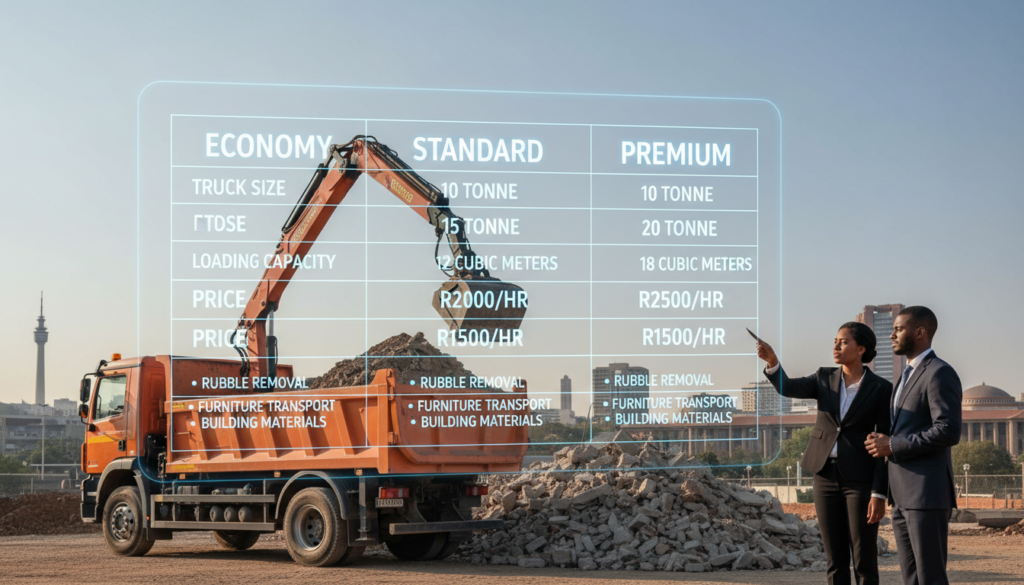
Market references: prices can start from R450 per load in select small cases. Typical single-load ranges sit between R3,500 and R6,500 depending on material and logistics.
When an hourly tipper makes sense
For staged works an hourly option can be more efficient. Rates commonly fall between R191 and R316 per hour when you expect multiple short turns during a job.
Key cost drivers
- Material density — concrete and soil raise the disposal and transport cost.
- Load size — larger loads need bigger vehicle selection and may alter prices.
- Access time — tight access or long loading can increase on-site time.
- Distance to licensed facilities — further travel adds fuel and time costs.
- Timing — peak demand or urgent slots can affect availability and rates.
What a transparent quote includes
Every quote covers the vehicle, a qualified operator, travel, standard disposal fees and documentation. That means waste transfer notes and tipping receipts where requested.
“We price every job on clear facts — materials, access and load size — so the quote matches the project reality.”
| Service type | Typical range | Best use-case |
|---|---|---|
| Small single load | R3,500–R6,500 | Home renovations, light demolition |
| Minimum/spot collection | R450 | Very small staged clears |
| Hourly tipper | R191–R316 | Staged works, phased removal |
Grab truck vs skip hire in Pretoria: speed, permits and total value – Grab truck hire for rubble
When choosing between direct collection and a site container, speed and permits usually decide the best option in Pretoria.
Permit considerations: placing a skip on public roads or pavements often needs a municipal permit. Typical ranges sit between R300 and R800 depending on location and duration. Local regulations can also require reflective signage or traffic control in busy CBD streets.
When direct collection wins
Direct collection clears a site in one visit — typically 30–60 minutes on accessible jobs. That makes it ideal for scattered rubble removal on estates, tight driveways and renovation work where trades need space kept clear.
Benefits: reduced downtime, fewer vehicle movements and no permit delays when you avoid placing a container on the street.
When a skip can still be practical
A skip is useful on long projects where garden waste or construction waste accumulates slowly. If you have secure on-site space and steady waste build-up, a container reduces repeated bookings and can be more convenient overall.
Scenario comparison
| Scenario | Best option | Why |
|---|---|---|
| Garden clearance (small estate) | Direct collection | Quick clearance, tight driveways, avoids permit cost |
| Small renovation waste (single-day clear) | Direct collection | Fast removal, minimal downtime for trades |
| Heavy soil / demolition loads | Skip hire | Ongoing disposal needs, secure space, fewer trips |
“For short, intense clean-ups we often find direct collection offers the better total value once permits and time are included.”
In Pretoria contexts — from CBD loading bays to suburban estates — we help you weigh permit costs, on-site access and project timing so you pick the most efficient waste removal route.
Grab truck hire for rubble: Conclusion
Handyman Pretoria — a clear chain of custody and quick on-site action reduce downtime on every project. We deliver fast, compliant rubble removal that keeps sites safe and trades working to schedule.
Our service offers 30–60 minute loading windows, licensed disposal routes and full documentation so your waste and disposal records stay audit-ready. This makes waste removal predictable and accountable.
Choose the right vehicle capacity, stage materials clearly and confirm access. We match the right fleet to site access, improve waste management outcomes and cut collection time with local routing knowledge across Pretoria.
Request a quote by sharing load details, material types and preferred timing and we’ll recommend the best-value option for every job. Handyman Pretoria is the reliable choice and we will make the removal simple and efficient.